Sinus Lift Surgery

Sinus Lift Surgery in Singapore
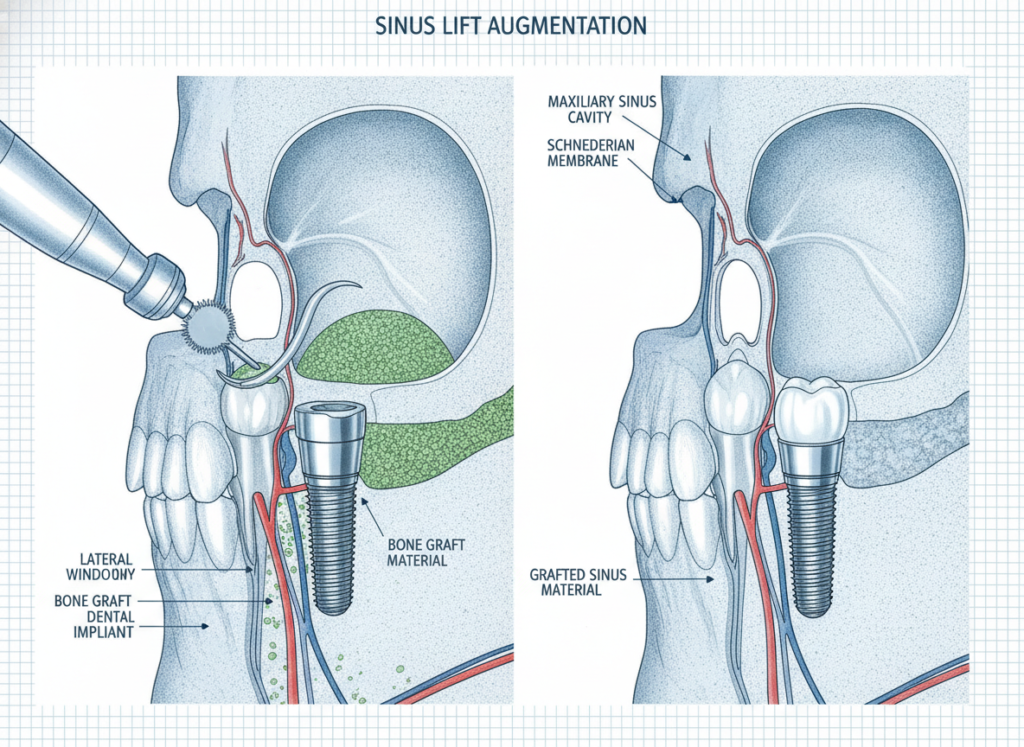
Sinus lift surgery helps add bone support in the upper jaw when there is not enough bone for dental implant placement. It is commonly recommended for patients who need dental implants in the upper back teeth area, where the sinus may be close to the jawbone.

What Is Sinus Lift Surgery?

Sinus lift surgery, also known as sinus augmentation, is a dental surgical procedure that adds bone to the upper jaw near the back teeth. It is usually done when there is not enough bone height to support a dental implant safely.
The upper back jaw is located close to the maxillary sinus, which is an air space above the upper jaw. When teeth have been missing for a long time, the jawbone in that area may shrink. In some patients, the sinus may also sit naturally low or expand closer to the jawbone after tooth loss. This can make implant placement in the upper back jaw more complex.
During sinus lift surgery, the sinus membrane is gently lifted and bone graft material is placed beneath it. This helps create more bone support for future dental implant placement. In some cases, sinus lift surgery may be done before implant placement. In other cases, it may be done during implant placement, depending on the existing bone condition.
At Best Smile Dental, our dentist will assess your jawbone, sinus position and implant suitability using clinical examination and imaging such as X-rays or CBCT scans before recommending sinus lift surgery.

What Are the Maxillary Sinuses?

The maxillary sinuses are air spaces located above the upper jaw, near the cheek area. They are part of the sinus system and sit close to the roots of the upper back teeth.
In dentistry, the maxillary sinuses are important because they may affect dental implant planning for the upper molars and premolars. When the upper back teeth are missing, the bone in that area may reduce over time. As a result, there may not be enough bone height between the mouth and the sinus for a dental implant to be placed safely.
A sinus lift helps create more vertical bone support in this area. This allows the dentist to plan dental implant treatment more safely and predictably where suitable.

When Do You Need Sinus Lift Surgery?

You may need sinus lift surgery if you are planning for dental implants in the upper back jaw but do not have enough bone support.
Common reasons include:
01
Bleeding Gums
02
Swollen, Red or Tender Gums
03
Bad Breath that Does Not Improve
04
Gum Recession or Teeth Looking Longer
05
Loose Teeth or Gaps Forming Between Teeth
06
Pain or Discomfort When Chewing
07
Heavy Tartar Build Up Around the Gumline
08
Deep Gum Pockets
Our dentist will examine your condition and explain whether sinus lift surgery, bone grafting, dental implant treatment, bridge, denture or another option is more suitable for you.

Sinus Lift Surgery & Dental Implants

Sinus lift surgery is often related to dental implant treatment. A dental implant needs enough bone to hold the implant fixture securely. If the bone in the upper back jaw is too thin, or if the sinus is too close to the jawbone, the implant may not have enough support.

A sinus lift helps create space for bone graft material in the upper jaw. After healing, the added bone may provide better support for implant placement.
Depending on your case, there are two possible treatment approaches.
Sinus Lift Before Implant Placement
If there is not enough bone to support an implant immediately, sinus lift surgery may be done first. The grafted area will then need time to heal before implant placement is planned.


This approach may be recommended when the existing bone height is very limited or when the dentist needs to allow the grafted area to mature before placing the implant.
Sinus Lift During Implant Placement
If there is some existing bone support, sinus lift surgery may be done during the same appointment as implant placement. This depends on your jawbone condition, sinus position, implant plan and overall treatment complexity.

Our dentist will advise which approach is more suitable after assessing your X-rays or CBCT scan.

External and Internal Sinus Lift

There are different ways to perform a sinus lift, depending on the amount of bone available and the treatment plan.

External Sinus Lift

An external sinus lift is usually used when more bone height is needed in the upper back jaw. The dentist creates access through the side of the upper jaw, gently lifts the sinus membrane and places bone graft material into the area.
This approach is commonly used for more significant bone deficiency before or during implant treatment.

VS

Internal Sinus Lift

An internal sinus lift, also known as a transcrestal sinus lift, is usually used when only a smaller amount of sinus lifting is needed. It is done through the implant site and may be suitable when there is already enough existing bone support.
The right approach depends on your bone height, sinus anatomy, implant plan and dentist’s assessment.

Why Choose Best Smile Dental for Sinus Lift Surgery?

Best Smile Dental provides sinus lift surgery for suitable patients who need additional upper jawbone support before or during dental implant treatment. Our dentist will assess your jawbone, sinus position, gums and bite before recommending a suitable treatment plan.

3D CBCT assessment for jawbone and sinus planning where needed

Dental implant and bone support assessment

Sinus lift and bone augmentation treatment planning

Over 500 dental implant procedures performed

Clear explanation of risks, benefits, alternatives and estimated fees

MediSave claim assistance where applicable

Long-term maintenance support for implant health

What to Expect During Sinus Lift Surgery

01

Consultation and Assessment

Our dentist will examine your teeth, gums, missing tooth area and upper jawbone. X-rays or CBCT scans may be recommended to assess the amount of bone available and the position of the maxillary sinus.

02

Treatment Planning

Our dentist will explain whether sinus lift surgery is needed before or during implant placement. You will also be informed about the treatment plan, estimated fees, healing timeline, risks, benefits and alternatives before you decide.

03

Local Anaesthetic

The treatment area will be numbed with local anaesthetic to keep you comfortable during the procedure. You should not feel sharp pain, although you may feel some pressure or vibration.

04

Sinus Lift and Bone Support

The dentist will access the upper jawbone near the missing back teeth area. The sinus membrane is gently lifted, and grafting material is placed to increase bone support in the area.

05

Stitches and Healing

The gum is closed with stitches and the area is allowed to heal. Healing time varies depending on your bone condition, graft size, implant plan and overall oral health.

06

Implant Planning

If the sinus lift is done before implant placement, the implant may be placed after the grafted area has healed. If the sinus lift is done together with implant placement, the implant will still need time to integrate with the jawbone before the final crown, bridge or denture is fitted.

Cost of Sinus Lift Surgery in Singapore

The cost of sinus lift surgery in Singapore depends on the type of sinus lift required, amount of bone support needed, sinus condition, treatment complexity and whether implant placement is done at the same time.

At Best Smile Dental, our dentist will assess your condition first and provide a clear treatment plan with estimated fees before you decide.

Additional charges may apply for consultation, X-rays, CBCT scan, surgical consumables, medication or other supporting treatments where required.

CHAS for Sinus Lift Surgery

CHAS subsidies are generally not applicable for sinus lift surgery. However, CHAS may apply for selected related dental treatments such as consultation, X-rays, extractions, crowns or dentures, subject to eligibility and claim limits.

MediSave for Sinus Lift Surgery

External sinus lift surgery may be MediSave claimable for eligible Singapore Citizens and Permanent Residents, subject to the assigned surgical code, CPF/MOH claim limits, available MediSave balance and patient eligibility.

Internal sinus lift, also known as transcrestal sinus lift, is generally not MediSave claimable. Our dentist will assess your bone condition, sinus position and implant plan before advising which approach is suitable for you.
Dental Treatment / Procedure Maximum MediSave Claimable Amount
Sinus Lift Up to S$2,220
The above refers to the maximum MediSave claimable amount, subject to eligibility, assigned surgical code, available MediSave balance and treatment complexity.
MediSave applies only to eligible surgical components. Non-surgical components such as consultation fees, X-rays, CBCT scan, implant crown and other non-surgical fees are not MediSave claimable.

Risks of Sinus Lift Surgery

Like any surgical dental procedure, sinus lift surgery may involve certain risks. These may include swelling, bleeding, bruising, infection, sinus discomfort, delayed healing or failure of the grafted area to heal as expected.
One possible risk is tearing of the sinus membrane during surgery. If this happens, the dentist will assess the situation and advise whether the area can be managed during the same visit or whether healing time is needed before continuing treatment.
Smoking, poor oral hygiene, uncontrolled medical conditions and existing sinus problems may affect healing. Our dentist will review your medical history and explain the risks before treatment.

Aftercare for Sinus Lift Surgery

After sinus lift surgery, mild swelling, soreness, bruising or discomfort may happen for a few days. Our dentist will provide aftercare instructions to support healing.
Avoid blowing your nose during the early healing period, as this may create pressure in the sinus area. If you need to sneeze, try to keep your mouth open to reduce pressure.
Avoid smoking, drinking alcohol, strenuous exercise, forceful rinsing and chewing hard food near the treated area during early healing. Take any medication as prescribed and keep the area clean as instructed.
Attend review appointments so the dentist can monitor healing and advise when the next stage of implant treatment can be planned.

Frequently Asked Questions

Is sinus lift surgery painful?
A: Sinus lift surgery is done with local anaesthetic to keep the treatment area numb. You should not feel sharp pain during the procedure, although you may feel pressure or vibration. After treatment, mild swelling, soreness or discomfort may happen for a few days.
How do I know if I need sinus lift surgery before a dental implant?
Our dentist will examine your upper jawbone and may recommend X-rays or a CBCT scan to check the bone height and sinus position. A sinus lift may be needed if there is not enough bone support for an implant in the upper back jaw.
Why is sinus lift surgery needed for upper back teeth implants?
The upper back teeth are close to the maxillary sinus. If the jawbone is too thin or the sinus sits too low, there may not be enough bone to hold a dental implant securely. A sinus lift helps create more bone support for implant placement where suitable.
What is the difference between external and internal sinus lift?
An external sinus lift is usually used when more bone height is needed. An internal sinus lift, also known as a transcrestal sinus lift, may be used when only a smaller amount of sinus lifting is required. The suitable approach depends on your bone condition and implant plan.
Can sinus lift surgery and dental implant placement be done on the same day?
In some cases, sinus lift surgery and implant placement may be done during the same appointment. This depends on the amount of existing bone support, sinus condition and treatment complexity. If there is not enough bone, the sinus lift may need to heal first before implant placement.
How long does it take to heal after sinus lift surgery?
Healing time varies depending on the amount of bone support needed, your bone condition, oral health and whether implant placement is done at the same time. Some patients may need a few months of healing before the next stage of implant treatment.
What should I avoid after sinus lift surgery?
Avoid blowing your nose, smoking, forceful rinsing, strenuous exercise and chewing hard food near the treated area during the early healing period. If you need to sneeze, try to sneeze with your mouth open to reduce pressure in the sinus area.
What happens if I do not have enough bone but skip sinus lift surgery?
If there is not enough bone in the upper back jaw, implant placement may not be suitable or may carry a higher risk of complications. Our dentist will explain whether sinus lift surgery, another type of bone support procedure, bridge, denture or another treatment option is more suitable.
Can I use MediSave for sinus lift surgery?
External sinus lift surgery may be MediSave claimable for eligible Singapore Citizens and Permanent Residents, with a maximum claimable amount of up to S$2,220. Internal or transcrestal sinus lift is generally not MediSave claimable. The final claim amount depends on the surgical code, CPF/MOH claim limits, patient eligibility and available MediSave balance.
Is CHAS claimable for sinus lift surgery?
CHAS subsidies are generally not applicable for sinus lift surgery. However, CHAS may apply for selected related dental treatments, subject to eligibility and claim limits.
Is sinus lift surgery always required for dental implants?
No. Sinus lift surgery is only needed when there is insufficient bone height in the upper back jaw or when the sinus is too close to the planned implant area. Our dentist will assess your condition before recommending it.

Ready to Book Your Dental Appointment?

Schedule your visit with Best Smile Dental and let our team assist you with your dental care needs.
About Us

Best Smile Dental is a neighbourhood dental clinic in Upper Boon Keng, Singapore, led by Dr Javious Lim. We provide gentle, modern dentistry designed to help you smile with confidence. From routine dental care to implants, Invisalign and wisdom tooth surgery, Best Smile Dental provides comprehensive treatment under one roof in Upper Boon Keng.